
Three Humanities Professors Selected as 2026 Faculty Fellows
Three College of Humanities professors have been selected as 2026 Faculty Fellows: Isabelle Freiling (communication), Matt Haber (philosophy), and Leandra Hernández (communication). Faculty Fellows receive a semester of full release time from teaching and administrative responsibilities in order to spend time advancing scholarly or creative research projects.
Isabelle Freiling

Matt Haber

Leandra Hernández
Wanda Pillow, dean of the College of Humanities, says, "Many congratulations to professors Freiling, Haber, and Hernandez on being awarded Faculty Fellowships; we are delighted to once again have a strong showing of Humanities scholars among the Faculty Fellows. This is an important recognition of the enduring value and impact of humanities research, and we look forward to supporting them as they advance their projects.”
Read on for what each of the Faculty Fellows will be pursuing in the upcoming year!
Isabelle Freiling, Communication
Isabelle Freiling, assistant professor of communication, will be working on a project titled “Navigating AI Hallucinations: A Generative AI Usage Framework Integrating Epistemic and Directional Goals” during her time as a Faculty Fellow. She will be launching a new investigation in her overall research program, studying how users’ goals as they interact with generative AI make a difference in how much it matters to them whether or not the AI provides accurate information. As Freiling puts it, “In what context does it matter if AI-generated information might be false? It probably depends on how or for what people use it.”
Many of the mental shortcuts, or heuristics, that humans typically use to assess the trustworthiness of information come from human-to-human interaction contexts. For example, in seeking reliable health information, we are likely to lean on whether the information “sounds” expert in terms of fluency and certainty in the delivery. However, these heuristics are unreliable in an AI context, since generative AI results are all based on predictive algorithms, which means that if something sounds certain, it does not mean that it is well researched or accurate. We would expect that to be the case, though, when the information comes from a human. In other words, all results from generative AI are “made up,” because that is inherent to the technology itself. So at what point do we understand AI-generated content to be “false” or the result of a hallucination—and when does it matter?
Freiling seeks to answer this very question, combining frameworks on how people make sense of information in general with frameworks of how people are using AI. Freiling is looking forward to the research, saying, “I'm excited about combining models about psychological processing of information with epistemic AI usage models.”
Ultimately, she contends, we need new heuristics for understanding information itself within the generative AI context; the way we have previously understood concepts like truth and validity may not apply the same way in modern information ecosystems.
“This is going to take a while,” says Freiling, “since it runs counter to the way humans typically work. Part of it is knowing that you cannot trust something based on how certain or authoritative it sounds when it comes from AI, and having the media—or rather AI—literacy to look at other markers in order to assess accuracy.”
Matt Haber, Philosophy
Matt Haber, associate professor of philosophy, will be launching a project entitled “Entangled Lineages and Biological Individuals,” exploring newer accounts of evolution and the “ways lineages behave, interact, and are structured.” Haber, who has argued for “Biology’s Einstein Moment” where absolutism is acknowledged to be a fiction and the specificity of one’s stance must be made clear, is eager to begin working on this philosophy of science project.
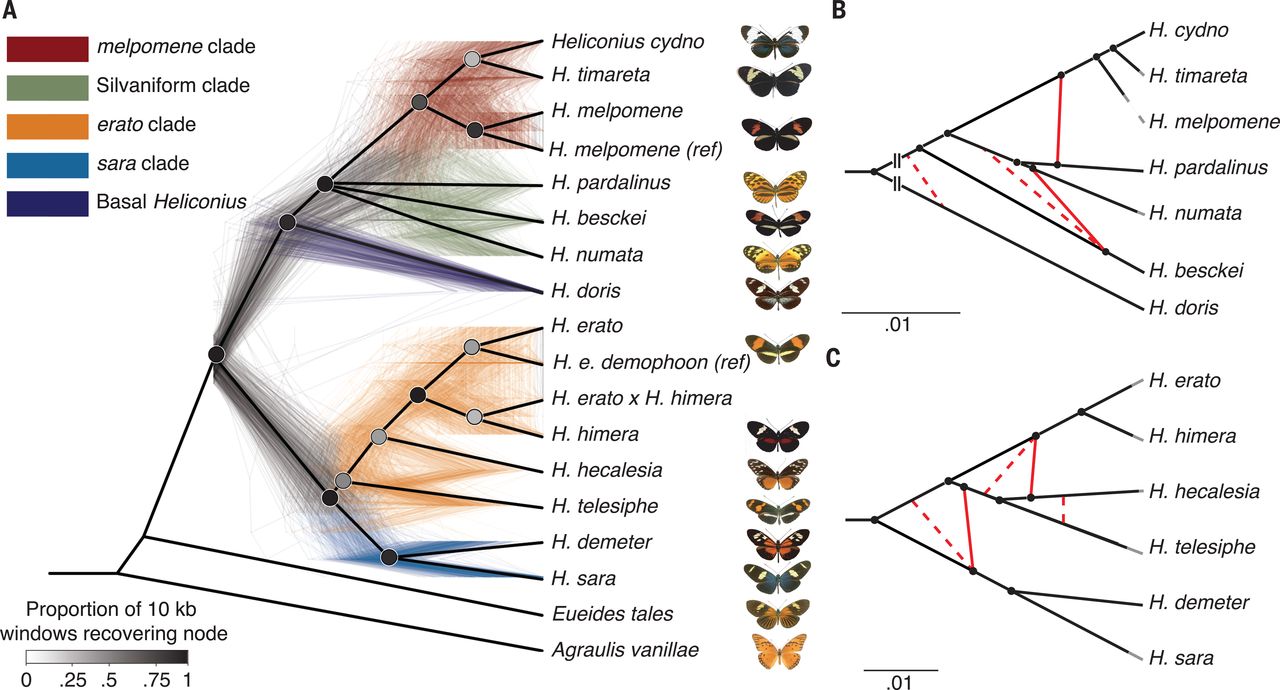
Edelman, et al. (2019). Genomic architecture and introgression shape a butterfly radiation. Science, 366 (6465): 594–599. (Figure 1).
Older models of evolution and biological lineages were clear, distinctive lines branching out like a tree, each line showing a clear and distinct species. New models of evolution have a layer of fuzziness to them, telling more accurate but less tidy stories. Looking at these entangled lineages through a lens of process ontology, Haber is launching into an expanded account of biological individuality. In other words, what defines a biological individual—a single ant, for example—is not necessarily a set of static characteristics which the ant does or does not possess, but rather how the ant is situated within a web of historically situated biological processes.
Haber’s research will generate new models for how lineages are entangled, explain how those models impact biological theories of evolution and development, and explore how new models might change the methods scientists use to study evolution and determine research questions.
These new models could potentially have transferable impact; not only do they provide clarity within the realm of science, more accurately reflecting the biological world around us, but they also provide a thought model for living in an era with big data. How do you look at a huge set of complicated, tangled data, and make the best sense of it? This is a question with which many of us inside and outside of science will have to contend.
Ever an experiential teacher, Haber is excited about collaborating with the student researchers in the Philosophy of Science lab as part of his time as a Faculty Fellow. The research process, he says, is full of unknowns: “I always tell my students, ‘You never know the impact of what you’re going to do. You can't know ahead of time. It may not have an impact while you’re alive—or it might! You just don't know.’ But that's how research works. We just have to try and generate as much knowledge as we can and some of it will get picked up. Some of it will be impactful.”
Leandra Hernández, Communication
Leandra Hernández, associate professor of communication, will be working on a book project entitled “Post-Roe Entanglements: Journalism Ethics, Democracy, & News Coverage of Reproductive Feminicide.” Her research looks at the heightened risk of violence that pregnant women and birthing individuals experience, particularly after the overturn of Roe v. Wade. The project first developed when Hernández recognized a pattern of news reports of pregnant women being attacked or killed, and their unborn children stolen. She noticed that news framing varied widely—the same violent incidents elicited either humane and empathetic news coverage, or sensationalized reporting—and set out to determine the reasons for the disparate treatment.
Hernández’ project brings together feminist news theory, journalism ethics, and health communication to theorize this sobering topic; her own background as a journalist informs this area of research. She explores concerns related to citizenship and health agency in case studies such as the criminalization of miscarriage and stillbirth and the increase in legislation related to feticide.
The book will be bridging a divide in the literature between the somewhat siloed disciplines of health communication and journalism studies. Says Hernández, “One of the tensions is not only how to merge those areas, but how best to communicate to two different audiences—I’m thinking about journalistic framing of a public health problem.”
Hernández is enthusiastic not only about the research itself, but also the community implications. “It’s so important to build collaborations so researchers, journalists, and public health practitioners are able to engage in more informed, intentional collaborations,” she says, continuing “One of my goals with this project is to work with journalist colleagues to create a trauma-informed journalism toolkit specifically for this context. I want to go beyond thinking about empathy and trauma and violence writ large, and explore how we actually help support journalists who are reporting on reproductive violence. As an applied communication scholar, the doing of the outcomes is always what's most important to me.”